
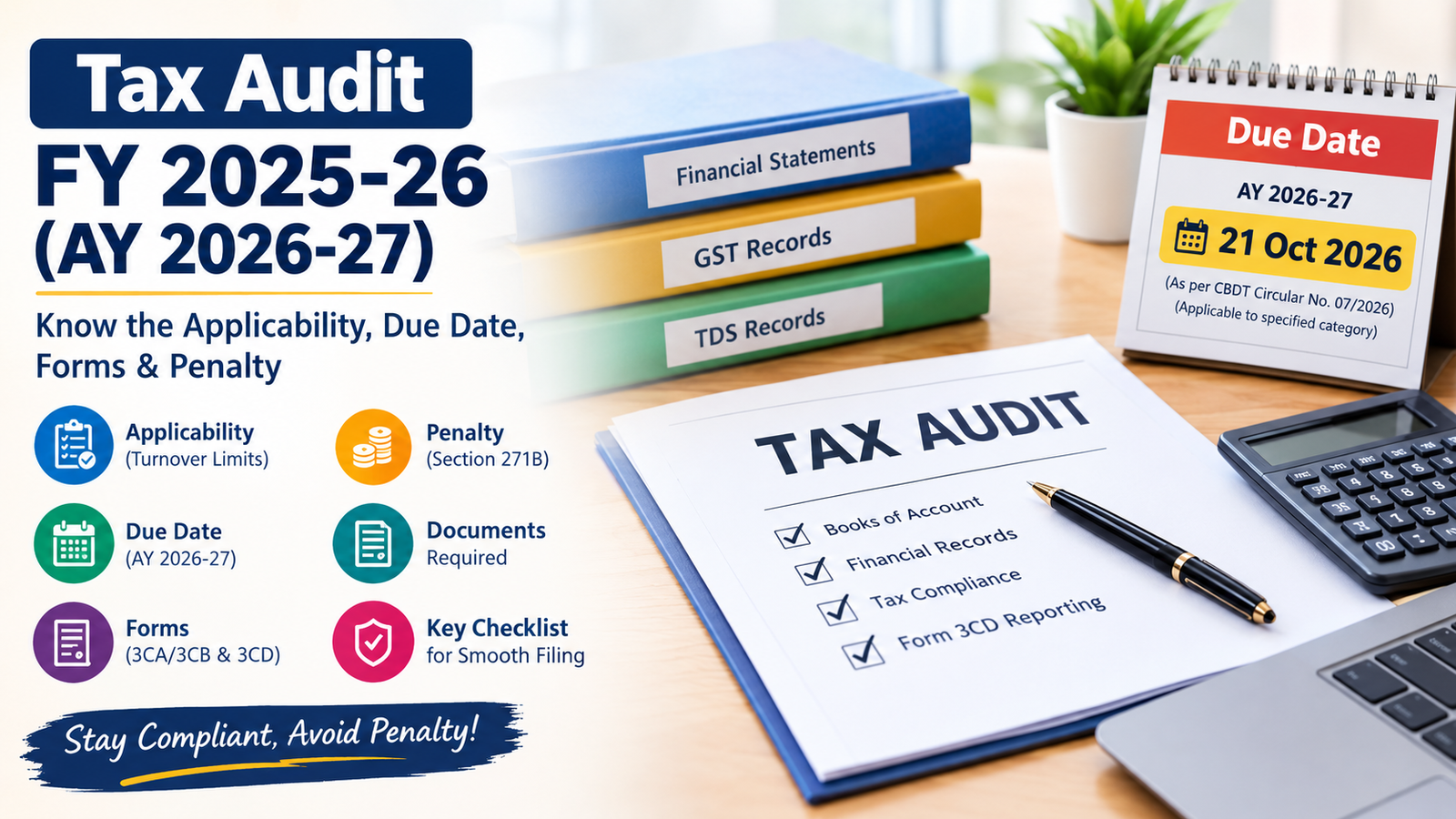
Tax Audit for FY 2025-26 (AY 2026-27)
Tax Audit for FY 2025-26 (AY 2026-27): Complete Guide to Tax Audit Applicability, Due Date, Forms & Penalty
Tax Audit for Financial Year (FY) 2025-26, relevant to Assessment Year (AY) 2026-27, is an important compliance requirement for businesses, professionals and certain taxpayers whose accounts fall within the prescribed provisions of the Income Tax Act.
A tax audit is not merely a formality. It involves examination of the taxpayer’s books of account, financial records, tax-related transactions and other particulars by a Chartered Accountant (CA), followed by submission of the prescribed Tax Audit Report to the Income Tax Department.
For FY 2025-26, taxpayers should pay particular attention to the applicable tax-audit threshold, cash transaction conditions, presumptive taxation provisions, Form 3CD disclosures and the applicable filing deadline.
Important: FY 2025-26 / AY 2026-27 Tax Audit Reports are governed by the Income-tax Act, 1961 and are filed in Form 3CA/3CB along with Form 3CD. The Income Tax Department has specifically clarified this transition position.
What is Tax Audit?
Tax Audit means an audit of the accounts of a taxpayer by a Chartered Accountant in accordance with the provisions of the Income-tax Act.
The principal provision governing tax audit for FY 2025-26 is Section 44AB of the Income-tax Act, 1961.
The objective of tax audit is to:
- Verify whether books of account and financial records are properly maintained.
- Report prescribed financial and tax particulars to the Income Tax Department.
- Identify specified transactions and tax-compliance issues.
- Ensure proper reporting of deductions, disallowances and other tax-related matters.
- Improve transparency and accuracy in the income-tax return.
The Tax Audit Report generally contains information regarding turnover, profit, depreciation, statutory payments, TDS/TCS-related matters, related-party transactions, loans and deposits, GST-related information and other particulars prescribed under Form 3CD.
Who is Required to Get Tax Audit for FY 2025-26?
Tax audit applicability primarily depends upon the nature of activity, turnover/gross receipts and the method of taxation adopted by the taxpayer.
1. Business
A person carrying on business is generally required to get the accounts audited where the total sales, turnover or gross receipts from business exceed:
₹1 Crore
However, the threshold is increased to:
₹10 Crore
where:
- Aggregate cash receipts during the relevant previous year do not exceed 5% of total receipts, and
- Aggregate cash payments during the relevant previous year do not exceed 5% of total payments.
The Income Tax Department confirms that the ₹10 crore threshold continues for cases satisfying these cash transaction conditions.
Example
Suppose a business has:
- Turnover: ₹7.50 crore
- Cash receipts: ₹15 lakh
- Total receipts: ₹7.50 crore
Cash receipts are:
₹15 lakh ÷ ₹7.50 crore × 100 = 2%
If the cash payment condition is also satisfied, the taxpayer may fall within the ₹10 crore threshold rather than the basic ₹1 crore threshold.
However, each case should be examined based on the actual nature and composition of receipts and payments.
2. Professionals
For specified professions, tax audit becomes applicable where the gross receipts exceed ₹50 lakh during the previous year.
Examples of specified professions may include:
- Legal professionals
- Medical professionals
- Architects
- Engineers
- Accountants
- Technical consultants
- Interior decorators
- Certain other notified professions
Therefore, a professional having gross receipts of more than ₹50 lakh should examine tax-audit applicability carefully.
3. Taxpayers Covered by Presumptive Taxation
Tax audit can also become applicable in certain situations involving presumptive taxation schemes.
For example, where a taxpayer is eligible for a presumptive taxation scheme but chooses to declare income in a manner that does not comply with the applicable presumptive provisions, audit requirements may arise subject to the specific conditions of the relevant section.
Therefore, taxpayers should not determine tax-audit applicability merely by looking at turnover.
The following should also be examined:
- Whether presumptive taxation is applicable;
- Whether the taxpayer has opted for or opted out of the scheme;
- Income declared in the return;
- Previous-year presumptive taxation history; and
- Conditions prescribed under the relevant provisions.
Tax Audit Limit for FY 2025-26 at a Glance
| Category | General Threshold |
|---|---|
| Business | ₹1 Crore |
| Business where cash receipts and payments do not exceed 5% | ₹10 Crore |
| Specified Profession | ₹50 Lakh |
| Presumptive taxation cases | Depends upon applicable provisions and circumstances |
Note: Threshold applicability should always be examined with reference to the exact provisions applicable to the taxpayer.
What is the Due Date for Tax Audit Report for AY 2026-27?
Normally, the Tax Audit Report is required to be furnished one month before the due date for filing the corresponding Income Tax Return.
For AY 2026-27, the Income Tax Department initially specified 30 September 2026 as the Tax Audit Report due date for taxpayers whose corresponding ITR due date was 31 October 2026. (Income Tax Department)
Important Latest Update
The CBDT issued Circular No. 07/2026 dated 28 September 2026 extending certain AY 2026-27 deadlines.
For taxpayers covered by the specified category referred to in the circular:
- Tax Audit Report due date: extended from 30 September 2026 to 21 October 2026
- Income Tax Return due date: extended from 31 October 2026 to 21 November 2026
The extension is not a blanket extension for every taxpayer. It applies to the persons specified in the relevant provision mentioned in the CBDT circular. (Income Tax Department)
Therefore, taxpayers should identify their exact category before relying on the extended date.
What Forms are Required for Tax Audit for FY 2025-26?
For FY 2025-26 / AY 2026-27, the existing forms under the Income-tax Act, 1961 continue to apply.
There are mainly two types of Tax Audit Reports:
Form 3CA + Form 3CD
Form 3CA is generally applicable where the accounts of the taxpayer are already required to be audited under another law.
For example, where statutory audit is required under another applicable law, Form 3CA is generally used along with Form 3CD.
Form 3CB + Form 3CD
Form 3CB is generally applicable where the taxpayer is required to get the accounts audited under the Income-tax Act but is not required to have the accounts audited under any other law.
Form 3CD contains the detailed statement of particulars required to be reported under the tax-audit provisions.
The Income Tax Department confirms that for FY 2025-26 / AY 2026-27, the applicable forms are Form 3CA/3CB and Form 3CD. (Income Tax Department)
What is Form 3CD?
Form 3CD is a detailed statement containing various particulars relating to the taxpayer’s business or profession.
Depending on the taxpayer and applicable provisions, the Tax Auditor may examine and report matters relating to:
- Nature of business or profession
- Books of account maintained
- Turnover and gross receipts
- Accounting method
- Changes in accounting method
- Depreciation
- Expenses and disallowances
- Statutory liabilities
- Payments covered under specified provisions
- Loans and deposits
- Cash transactions
- Related-party transactions
- TDS/TCS compliance
- GST-related information
- Section-wise deductions
- Specified payments
- Unreported or inadmissible expenditure
- Other particulars prescribed in Form 3CD
Because Form 3CD contains extensive disclosures, taxpayers should begin the audit process well before the due date.
Documents Required for Tax Audit
A taxpayer should generally provide the following information and documents to the Chartered Accountant, depending upon the nature of business/profession:
Basic Documents
- PAN
- Aadhaar details, wherever relevant
- Income Tax login credentials/access for compliance
- Previous year’s Income Tax Return
- Previous year’s Tax Audit Report, if applicable
- Previous year’s financial statements
Books & Financial Records
- Cash Book
- Bank Book
- Ledger
- Journal
- Trial Balance
- Profit & Loss Account
- Balance Sheet
- Fixed Asset Register
- Stock records, wherever applicable
Banking & Financial Information
- All bank statements
- Loan statements
- Interest certificates
- Details of unsecured loans
- Details of advances
- Details of investments
GST Records
- GST returns
- GSTR-1
- GSTR-3B
- Annual return, wherever applicable
- GST turnover reconciliation
- Input Tax Credit details
- Electronic cash/credit ledger information
TDS/TCS Records
- TDS returns
- TDS challans
- Form 26AS
- AIS/TIS
- TDS certificates
- Details of TDS payable
- Details of TDS defaults, if any
Other Information
- Details of cash receipts and payments
- Details of loans and deposits
- Related-party transactions
- Details of specified payments
- Details of statutory dues
- Details of deductions claimed
- Details of foreign transactions, wherever applicable
- Details of fixed assets purchased/sold
- Any notices received from tax authorities
Tax Audit and GST Reconciliation
One of the important areas during tax audit is reconciliation between:
Books of Accounts ↔ GST Returns ↔ Income Tax Return
Differences may arise because of:
- Credit notes
- Debit notes
- Exempt supplies
- Non-GST supplies
- Advances
- Year-end adjustments
- GST-inclusive accounting
- Sale of fixed assets
- Other income
- Timing differences
Therefore, taxpayers should reconcile turnover before finalising the Tax Audit Report.
Tax Audit and Cash Transactions
Cash transactions are particularly important because the tax-audit threshold can depend upon the percentage of cash receipts and payments.
Businesses should maintain proper records of:
- Cash sales
- Cash purchases
- Cash expenses
- Cash receipts
- Cash payments
- Loans received in cash
- Loans repaid in cash
- Advances received/paid in cash
Apart from tax-audit applicability, separate provisions of the Income-tax Act can restrict or disallow certain cash transactions.
Therefore, being below the tax-audit threshold does not automatically mean that all cash transactions are tax-compliant.
Penalty for Failure to Get Tax Audit Done
Failure to comply with the tax-audit requirement may attract penalty under Section 271B of the Income-tax Act, 1961.
The penalty is generally:
0.5% of total sales, turnover or gross receipts, subject to a maximum of ₹1,50,000.
However, penalty provisions should be read along with the provisions relating to reasonable cause. In appropriate circumstances, relief may be available where the taxpayer establishes reasonable cause for the failure.
Taxpayers should therefore avoid assuming that the penalty is automatically waived merely because the audit is completed after the due date.
Important Tax Audit Mistakes to Avoid
1. Checking only turnover
Tax-audit applicability cannot always be determined solely by turnover.
Presumptive taxation and other conditions must also be examined.
2. Ignoring cash transactions
The 5% cash receipt/payment conditions can be relevant to the ₹10 crore business threshold.
3. Mismatch between GST and books
Turnover reported in GST returns should be reconciled with books of account and the figures reported for income-tax purposes.
4. Ignoring TDS defaults
TDS-related non-compliance can have consequences while computing taxable income and reporting particulars in Form 3CD.
5. Last-minute preparation
Form 3CD contains numerous disclosure requirements. Waiting until the last few days can increase the possibility of errors and incomplete information.
6. Incorrect reporting of loans and cash transactions
Loans, advances and specified cash transactions should be reviewed carefully.
7. Not reviewing previous-year disclosures
Previous-year Tax Audit Reports can provide useful information regarding continuing transactions, accounting policies, depreciation, loans and other recurring matters.
Tax Audit Checklist for FY 2025-26
Before finalising the Tax Audit Report, taxpayers should consider the following checklist:
Business & Turnover
☐ Verify total turnover/gross receipts
☐ Reconcile turnover with GST returns
☐ Check cash receipts percentage
☐ Check cash payments percentage
☐ Review sales returns and credit notes
Expenses
☐ Verify major business expenses
☐ Check statutory payments
☐ Review employee-related payments
☐ Review interest and finance costs
☐ Check depreciation
☐ Identify potentially disallowable expenses
TDS/TCS
☐ Reconcile TDS payable
☐ Reconcile TDS returns
☐ Check Form 26AS/AIS
☐ Review TDS defaults
☐ Verify applicable TDS provisions
Loans & Cash
☐ Review loans received
☐ Review loans repaid
☐ Check cash transactions
☐ Review advances
☐ Verify confirmations where required
GST
☐ Reconcile GST turnover
☐ Reconcile ITC
☐ Check GST payable
☐ Review GST notices/demands
☐ Identify differences between GST and books
Finalisation
☐ Finalise financial statements
☐ Finalise tax computation
☐ Prepare Form 3CD information
☐ Review audit observations
☐ Obtain required confirmations
☐ File Tax Audit Report within the applicable due date
☐ Proceed with the relevant Income Tax Return filing
Tax Audit vs Statutory Audit – What is the Difference?
Tax Audit and Statutory Audit are not necessarily the same.
| Particular | Tax Audit | Statutory Audit |
|---|---|---|
| Main Purpose | Income-tax compliance | Compliance under applicable corporate/other law |
| Main Law | Income-tax Act | Relevant applicable law |
| Auditor | Chartered Accountant | Chartered Accountant, where applicable |
| Major Report | Form 3CA/3CB + Form 3CD | Applicable statutory audit report |
| Focus | Tax-related reporting and prescribed particulars | Financial statements and applicable legal requirements |
A taxpayer may be required to undergo both audits depending upon the nature and legal status of the entity.
Tax Audit for Companies, Firms, LLPs and Proprietorships
Tax-audit applicability depends on the taxpayer’s facts and applicable legal provisions.
Proprietorship
A proprietor may become liable for tax audit based on business turnover, cash transaction conditions and other applicable provisions.
Partnership Firm
A partnership firm may be subject to tax audit depending on turnover/gross receipts and applicable provisions.
LLP
An LLP may have tax-audit obligations depending upon the applicable provisions and circumstances.
Private Limited Company
Companies may already be subject to statutory audit under company law. Where income-tax tax-audit provisions are applicable, the prescribed income-tax audit reporting requirements must also be complied with.
Tax Audit for FY 2025-26: Special Transition Point
FY 2025-26 is particularly important because the Income-tax Act, 2025 comes into effect for the subsequent tax regime.
The Income Tax Department has clarified that the Tax Audit Report relating to FY 2025-26 / AY 2026-27 continues to be filed using the forms prescribed under the Income-tax Act, 1961, namely:
- Form 3CA
- Form 3CB
- Form 3CD
The new consolidated Form 26 applies to the subsequent Tax Year 2026-27. (Income Tax Department)
Therefore, taxpayers should not confuse the FY 2025-26 tax-audit forms with the new forms applicable to the subsequent tax year.
Frequently Asked Questions – Tax Audit FY 2025-26
Q1. What is the basic tax-audit turnover limit for business for FY 2025-26?
The general threshold is ₹1 crore. It can increase to ₹10 crore where the prescribed cash receipt and cash payment conditions are satisfied.
Q2. What is the tax-audit limit for professionals?
For specified professions, the gross-receipts threshold is ₹50 lakh.
Q3. What is the Tax Audit Report due date for AY 2026-27?
The standard due date was 30 September 2026 for relevant taxpayers. However, CBDT Circular No. 07/2026 has extended the audit-report deadline to 21 October 2026 for the specified category covered by the circular. (Income Tax Department)
Q4. Which forms are applicable for FY 2025-26?
Form 3CA or Form 3CB, as applicable, along with Form 3CD.
Q5. Is tax audit applicable if turnover is below ₹1 crore?
Not necessarily. Tax-audit applicability can arise under other provisions, including certain presumptive-taxation situations. The taxpayer’s complete facts should be examined.
Q6. Is GST registration mandatory for tax audit?
Tax audit and GST registration are separate compliance requirements. GST registration depends upon GST law and applicable thresholds/conditions, whereas tax audit is governed by income-tax provisions.
Q7. Can a tax audit report be filed after the due date?
A report filed after the applicable due date may result in consequences, including possible penalty under Section 271B, subject to the facts and reasonable-cause provisions.
Q8. Is tax audit the same as statutory audit?
No. They are separate compliance requirements, although the same Chartered Accountant may perform both where permitted and appropriate.
Why Should You Start Tax Audit Preparation Early?
Tax audit is a detailed compliance exercise rather than simply uploading a form.
Early preparation helps in:
- Identifying accounting errors
- Reconciling GST and books
- Checking TDS compliance
- Reviewing cash transactions
- Identifying potential tax disallowances
- Verifying loans and advances
- Completing Form 3CD disclosures
- Resolving accounting differences
- Avoiding last-minute filing issues
A proper tax-audit process can therefore help taxpayers maintain better tax compliance and documentation.
Conclusion
Tax Audit for FY 2025-26 / AY 2026-27 requires careful attention to turnover limits, cash transaction conditions, presumptive taxation provisions, Form 3CA/3CB, Form 3CD and the applicable filing deadline.
Taxpayers should not wait until the last date to determine whether tax audit is applicable. A detailed review of turnover, receipts, payments, books of account, GST records, TDS compliance, loans, cash transactions and other relevant information should be completed before finalising the Tax Audit Report.
Since the CBDT has issued a specific extension for certain AY 2026-27 taxpayers, the exact category of the taxpayer should be checked before determining the applicable deadline.
For professional assistance with Tax Audit for FY 2025-26 / AY 2026-27, Form 3CD preparation, tax computation, GST reconciliation, TDS reconciliation and Income Tax Return filing, taxpayers should consult a qualified Chartered Accountant or tax professional.
Official Reference
The latest tax-audit and deadline information should always be verified from the official Income Tax Department / CBDT notifications and circulars before filing.
Disclaimer: This article is intended for general educational and informational purposes only. Tax laws, rules, circulars and filing deadlines may change. The applicability of tax audit and the consequences of non-compliance depend upon the specific facts and circumstances of each taxpayer. Professional advice should be obtained before taking a tax position or filing a statutory report.
Suggested SEO setup for your website:
- SEO Title: Tax Audit FY 2025-26 (AY 2026-27): Limit, Due Date, Forms & Penalty
- Meta Description: Learn about Tax Audit for FY 2025-26 (AY 2026-27), including Section 44AB applicability, ₹1 crore/₹10 crore turnover limits, ₹50 lakh professional limit, Form 3CA/3CB/3CD, due dates, penalty and checklist.
- Primary Keyword:
Tax Audit FY 2025-26 - Secondary Keywords:
Tax Audit AY 2026-27,Tax Audit Limit FY 2025-26,Tax Audit Due Date AY 2026-27,Form 3CD,Section 44AB,Tax Audit Turnover Limit,Tax Audit Penalty - Suggested URL Slug:
/tax-audit-fy-2025-26-ay-2026-27/
Important publication note: Because this article discusses statutory deadlines, I recommend keeping the 29 September 2026 CBDT extension prominently updated on the live page. The Income Tax Department currently states that the extension to 21 October 2026 applies to the specified category, rather than universally to all tax-audit cases. (Income Tax Department)