
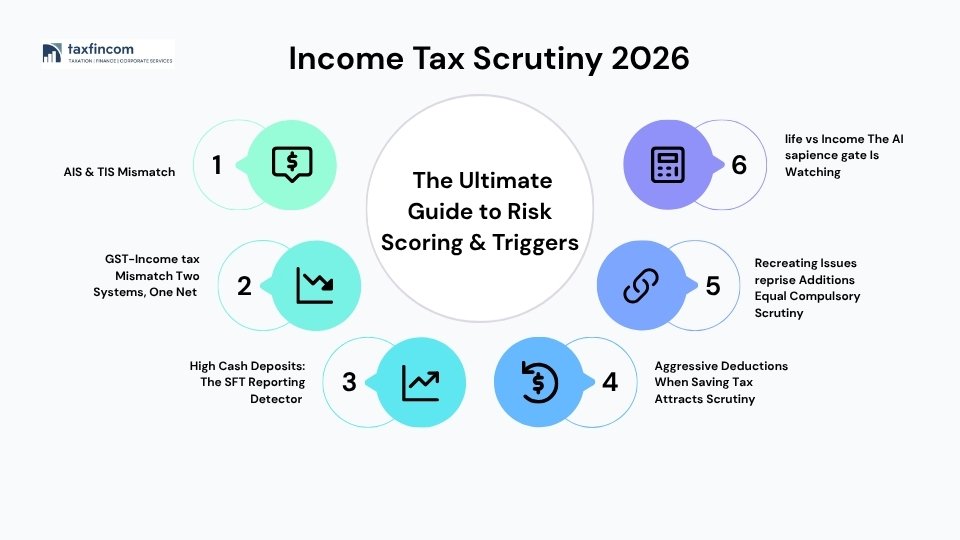
Income Tax Scrutiny 2026: The Ultimate Guide to Risk Scoring & Triggers
Every time, thousands of Indian taxpayers admit an income tax scrutiny notice, not because they have done a commodity wrong, but because their filings spark automated red flags in the Income Tax Department’s AI-powered threat-scoring system. The reality is blunt: the IT Department is no longer counting solely on mortal adjudicators. It’s using data analytics, machine literacy, and cross-verified databases to identify mismatches, life disagreements, and inconsistencies, and it’s doing this at scale.
Whether you are a salaried professional, a freelancer, a business proprietor, or an HNI (High Net Worth Individual), understanding how scrutiny is triggered can make all the difference. More importantly, knowing how to cover yourself with accurate, well-proven Income tax return filing services can help you stay clean, credible, and fully inspected.
This companion breaks down exactly what triggers scrutiny in 2026, and how using professional Online ITR filing services like TaxFincom can cover you before the notices ever arrive.
The Income Tax Dept uses data analytics and threat scoring to decide who gets a scrutiny notice. Then are the key triggers
1. AIS & TIS Mismatch The# 1 Red Flag in 2026
The Annual Information Statement (AIS) and Tax Information St (TIS) are comprehensive records collected by the Income Tax Department from banks, brokers, employers, and third parties. However, anticipate a notice if your Annual Information Statement (AIS) and Tax Information Statement (TIS) do not match your ITR.
This is now one of the most common triggers for scrutiny. The system automatically compares your AIS/TIS data against what you’ve declared in your return. A mismatch, indeed an honest oversight, gets flagged incontinently.
What most taxpayers do not realise is that AIS captures data from more than 50 reporting entities, including collective fund redemptions, interest income, tip credits, and property deals. Missing one of these in your ITR is enough to land you in the scrutiny line.
TaxFincom’s Income tax return filing services are designed to ensure your ITR syncs with AIS/TIS before submitting, barring mismatches before they cause problems.
2. GST-Income tax Mismatch Two Systems, One Net
Still, you need to understand that GST and Income tax data are now completely linked. If you are a business proprietor or professional operating under GST. However, it will raise a red flag every single time if your GST development does not match your ITR.
The department’s backend systems cross-verify GSTR-1, GSTR-3B, and ITR data contemporaneously. A declared development of ₹ 80 lakhs in GST but ₹ 50 lakhs in your income tax return is a mismatch that the system will catch automatically. Indeed, timing differences across fiscal years can produce disagreements that look suspicious.
For dealers, advisers, retailers, and MSMEs, this is a serious threat zone. Professional Online ITR filing services that understand both GST compliance and income tax law, like TaxFincom, are no longer voluntary. They’re essential.
3. High Cash Deposits: The SFT Reporting Detector
Cash deals remain under violent scrutiny. Cash deposits above ₹ 10 lakh in savings accounts or ₹ 50 lakh in current accounts spark SFT (Statement of Financial Deals) reporting directly to the Income Tax Department. However, you are at a significant threat If you’ve made large cash deposits and have not explained the source in your ITR.
This particularly affects small business owners, landlords entering rent in cash, agrarian income earners, and families managing common finances. The department’s AI tools are programmed to flag high-value cash overflows that do not correspond with declared income sources.
Always validate the source of large cash deposits, gift deeds, loan agreements, agrarian bills, and ensure these are duly reflected in your income tax filing. TaxFincom helps clients align cash overflows with declared income, so nothing looks out of place.
4. Aggressive Deductions When Saving Tax Attracts Scrutiny
Claiming surprisingly high deductions under Chapter VI-A or donations to unknown trusts can attract scrutiny. While deductions under Section 80C, 80D, 80G, and others are entirely licit, the threat arises when claims are disproportionate to income situations or appear inconsistent with previous years.
Donations to obscure or unverified trusts, exaggerated medical insurance decorations, or suddenly jumping from low to extremely high 80C investments without supporting substantiation are all patterns the threat-scoring machine is trained to describe.
A good rule of thumb is that every deduction you claim must be backed by empirical attestation. With TaxFincom’s Income tax return filing services, each deduction is reviewed for proportionality and attestation compliance, reducing your exposure dramatically.
5. Recreating Issues reprise Additions Equal Compulsory Scrutiny
Still, it may lead to mandatory scrutiny, If the department made a tax addition in your case ahead and you claim the same deduction again. This is one of the lesser-known but extremely important triggers that catches taxpayers off guard time after time.
The IT Department maintains literal records. However, if you repeat the same claim without addressing the original issue, the system flags it for obligatory review if a deduction or income head was disallowed in a filing assessment. Professionals managing action histories or assessees with previous notices must be especially careful then.
TaxFincom’s filing experts review previous time assessment orders before preparing your current return, ensuring you do not repeat patterns that have already drawn departmental attention.
6. life vs Income The AI sapience gate Is Watching
Still, the AI-driven Sapience Portal will flag it if your life charges do not match your declared income. This is one of the most important, and honestly unsettling, tools the department now uses.
The Sapience Portal summarizes data from credit card spends, foreign trips, luxury purchases, property enrollments, and, indeed, social media-linked fiscal data. An individual declaring ₹ 6 lakhs periodic income but holding ultra-expensive credit cards, reserving transnational leaves, and retaining multiple vehicles creates a profile inconsistency that the AI is designed to catch.
This particularly applies to freelancers, gig frugality workers, and business owners who may underreport income but maintain visible high-value cultures. Icing your declared income credibly matches your factual fiscal footprint is no longer just good practice; it’s a compliance necessity.
7. To Stay Under the Radar: The Compliance Checklist That Protects You
The smartest taxpayers in 2026 aren’t the ones taking the most aggressive positions; they are the ones who are the most accurate and harmonious. Then is what staying biddable actually looks like
- Attune ITR, AIS, 26AS, and GST data before filing. These four data aqueducts must tell the same fiscal story. Any divergence is an implicit detector.
- Document gift deeds, loan agreements, and cash sources at the time of the sale, not after you admit a notice. Retroactive attestation is far less believable.
- Be harmonious in your tax filings. Unforeseen changes in income, deductions, or declared means without clear explanations raise threat scores significantly.
- Respond to Verification queries instantly. Ignoring or delaying responses to the department’s e-communications automatically escalates your case to advanced scrutiny situations.
Tax compliance is about data, not luck. Stay on top of it.
Why TaxFincom Is the Trusted Choice for Online ITR Filing Services
Navigating India’s increasingly data-driven tax compliance geography requires more than just filling in a filing. It requires deep moxie in AIS/TIS conciliation, GST-income tax alignment, deduction attestation, and action history operation.
TaxFincom provides comprehensive Online ITR filing services tailored to salaried workers, freelancers, business owners, NRIs, HNIs, and anyone who wants their income tax return filed directly, compliantly, and strategically.
Clients who have used TaxFincom’s Income tax return filing services constantly report reduced notice threat, better deduction optimization, and complete peace of mind during filing season, knowing their returns have been reviewed by professionals who understand exactly what the department is looking for.
Take Control of Your Tax Filing, Before the Department Does
Do not stay for a scrutiny notice to take your income tax compliance seriously. The threat-scoring algorithms are already running. The AIS is already populated. The mismatches, if any, already live.
The question is whether you will fix them before filing or explain them after a notice arrives.
Connect with TaxFincom moment and experience Income tax return filing services that are designed for the data-driven compliance world of 2026. Professional review, precise conciliation, and complete attestation, every return, every time.
Train smart. train right. train with TaxFincom.