
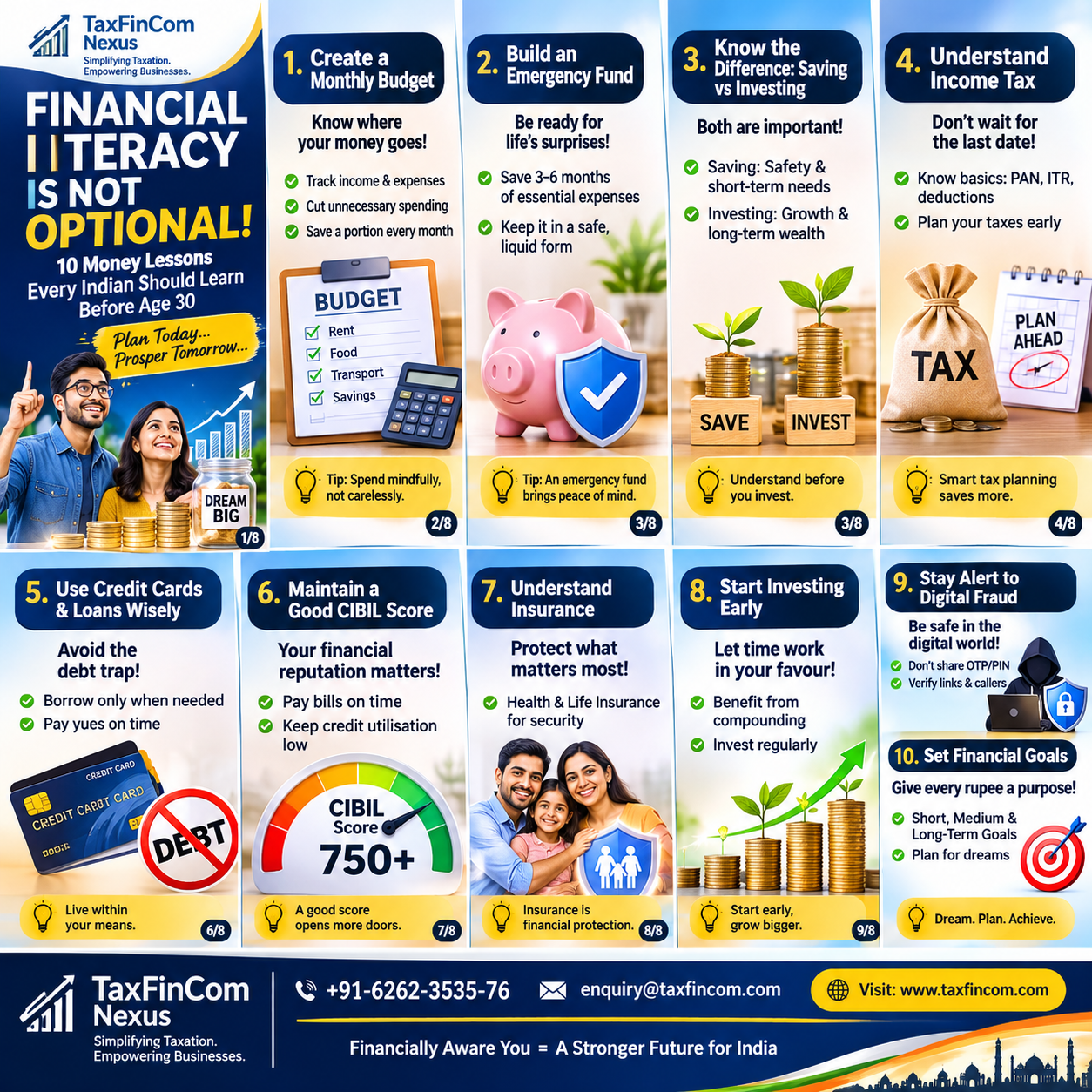
Financial Literacy Is Not Optional: 10 Money Lessons Every Indian Should Learn Before Age 30
Published by: TaxFinCom Nexus
Category: Financial Literacy | Personal Finance | Tax Awareness
Introduction: Earning Money Is Important, But Knowing How to Manage It Is More Important
Imagine two people earning the same salary of ₹50,000 per month.
The first person spends most of their income without maintaining a budget, has multiple credit card EMIs, does not understand income tax and has no emergency savings.
The second person maintains a monthly budget, saves regularly, understands taxation, manages debt carefully and invests according to their financial goals.
After five years, despite earning the same salary, their financial situations could be completely different.
What makes the difference?
Financial Literacy.
Financial literacy is the ability to understand and manage money wisely. It includes budgeting, saving, investing, borrowing, taxation, insurance and financial planning.
In today’s rapidly changing financial environment, where digital payments, instant loans, credit cards, online investments and financial scams have become common, understanding money is no longer optional.
It is a life skill.
Whether you are a student, salaried employee, freelancer, entrepreneur or young professional, learning basic financial principles before the age of 30 can help you avoid costly mistakes and build a more secure future.
At TaxFinCom Nexus, we believe that financial awareness should not be limited to finance professionals. Every individual deserves to understand how money works.
Let’s explore the 10 most important financial lessons every Indian should learn before turning 30.
1. Learn to Create a Monthly Budget – Know Where Your Money Goes
One of the biggest financial mistakes people make is spending first and saving whatever remains.
A better approach is to plan your income before spending it.
A monthly budget helps you understand how much money you earn, how much you spend and how much you can save.
For example, consider a young professional earning ₹40,000 per month.
A possible monthly budget could look like this:
| Expense Category | Monthly Amount |
|---|---|
| House Rent | ₹10,000 |
| Food & Groceries | ₹5,000 |
| Transportation | ₹3,000 |
| Utilities & Mobile | ₹2,000 |
| Family Support | ₹4,000 |
| Entertainment & Shopping | ₹3,000 |
| Savings & Investments | ₹8,000 |
| Emergency Fund | ₹5,000 |
| Total | ₹40,000 |
This is only an illustrative budget. Actual allocations should depend on an individual’s income, family responsibilities and living expenses.
What should you do?
- Record your income and expenses.
- Identify unnecessary spending.
- Set a monthly savings target.
- Review your budget regularly.
- Avoid spending more simply because your income increases.
Remember: You do not need to earn more money to start managing your money better.
You need to understand where your existing money goes.
2. Build an Emergency Fund – Be Financially Prepared for Unexpected Situations
Life is unpredictable.
You may suddenly face a medical expense, job loss, business slowdown, urgent family responsibility or unexpected repair expense.
Without savings, people often depend on credit cards, personal loans or borrowing from friends and relatives.
This can create unnecessary financial pressure.
An emergency fund is money kept separately to handle unexpected essential expenses.
How much should you save?
A commonly used financial planning guideline is to maintain emergency savings equivalent to 3–6 months of essential living expenses.
For example:
If your essential monthly expenses are ₹25,000:
- 3 months’ emergency fund = ₹75,000
- 6 months’ emergency fund = ₹1,50,000
If your income is irregular, you have dependants or you are self-employed, you may need a larger reserve.
Where should you keep your emergency fund?
Consider accessible and relatively low-risk options such as:
- Savings bank account.
- Suitable bank fixed deposits.
- Other liquid options after understanding their withdrawal conditions and risks.
Avoid investing your entire emergency fund in volatile assets such as equity shares or cryptocurrencies.
Your emergency fund is not meant to make you rich.
It is meant to protect you when life becomes financially difficult.
3. Understand the Difference Between Saving and Investing
Many people believe that saving and investing are the same thing. They are not.
Saving means keeping money aside for future needs while prioritising safety and accessibility.
Investing means putting money into financial assets with the objective of generating returns over time, while accepting some level of risk.
For example:
| Saving | Investing |
|---|---|
| Savings account | Mutual funds |
| Bank fixed deposit | Equity shares |
| Recurring deposit | Bonds |
| Emergency savings | Other suitable market-linked investments |
Before investing, understand:
- Your financial goals.
- Your investment time horizon.
- Your ability to tolerate risk.
- Liquidity requirements.
- Applicable charges and taxation.
Do not invest simply because a friend, influencer or social media advertisement recommends a particular product.
The golden rule: Understand an investment before putting your hard-earned money into it.
4. Understand Income Tax – Do Not Wait Until the Last Date to Learn About Taxation
Taxation is one of the most important financial subjects that every earning individual should understand.
Many people only think about income tax when the ITR filing deadline approaches. This can lead to poor tax planning, missed deductions or exemptions, incorrect disclosures and unnecessary interest or penalties.
Every individual should understand basic concepts such as:
- PAN and its importance.
- Financial Year and Assessment Year.
- Income Tax Return (ITR).
- Old and New Tax Regimes.
- TDS (Tax Deducted at Source).
- Form 26AS and Annual Information Statement (AIS).
- Advance Tax.
- Capital Gains Tax.
- Taxable and exempt income.
Example:
Suppose an individual receives a salary, earns bank interest and also earns income through freelance work.
Ignoring any one of these income sources while preparing an income tax return may result in an incorrect return.
Similarly, simply having TDS deducted does not automatically mean that your income tax compliance is complete.
You should review your income, tax credits and other applicable reporting requirements before filing your return.
Important advice: Income tax planning should begin at the start of the financial year, not at the end.
For professional assistance with income tax returns and tax compliance, consult TaxFinCom Nexus.
5. Use Credit Cards and Loans Wisely – Avoid the Debt Trap
Credit cards and loans can be useful financial tools when used responsibly.
However, careless borrowing can create long-term financial difficulties.
One common mistake is paying only the minimum amount due on a credit card.
When you pay only the minimum amount, the remaining outstanding balance may attract substantial interest and other applicable charges.
Similarly, taking multiple personal loans, consumer loans and credit card EMIs can reduce your monthly financial flexibility.
Before taking any loan, ask yourself:
- Do I genuinely need this loan?
- Can I comfortably afford the EMI?
- What is the actual interest rate?
- What are the processing fees and other charges?
- What is the total repayment amount?
- Will this loan affect my other financial goals?
Example:
If you borrow ₹2,00,000 at an annual interest rate of 15% for personal expenses, you must consider not only the EMI but also the total interest payable over the loan period.
A loan should support a genuine financial requirement, not encourage unnecessary lifestyle spending.
6. Understand Your CIBIL Score – Your Financial Reputation Matters
Your credit score is an important indicator of your credit repayment history and borrowing behaviour.
In India, credit information companies maintain credit reports based on information received from lenders.
A CIBIL Score is one such credit score, generally ranging from 300 to 900.
Banks and financial institutions may consider your credit history when evaluating loan and credit card applications.
What can negatively affect your credit profile?
- Missing EMI payments.
- Delaying credit card payments.
- Maintaining high credit utilisation.
- Applying for multiple loans within a short period.
- Defaults or settlements that are reflected in your credit report.
- Incorrect information in your credit report that remains unresolved.
How can you maintain a healthy credit profile?
- Pay EMIs and credit card bills on time.
- Avoid unnecessary borrowing.
- Monitor your credit report.
- Keep credit utilisation under control.
- Dispute incorrect entries with the relevant credit information company.
Remember, a good credit score does not guarantee loan approval, but responsible credit behaviour can improve your financial credibility.
7. Understand Insurance – Protect Your Family Before Chasing Returns
Financial planning is not only about earning, saving and investing.
It is also about protecting yourself and your family from unexpected financial risks.
Two important types of insurance that individuals should understand are:
A. Health Insurance
Medical expenses can create a significant financial burden.
Health insurance can help cover eligible hospitalisation and other medical expenses according to the policy terms.
B. Life Insurance
Life insurance can provide financial protection to your family in the event of your death, subject to the policy conditions.
If your family depends on your income, life insurance may be an important part of your financial protection plan.
What should you check before purchasing insurance?
- Coverage amount.
- Policy exclusions.
- Waiting periods.
- Premium affordability.
- Claim settlement conditions.
- Room rent restrictions, if applicable.
- Policy renewal conditions.
Do not purchase an insurance product only because someone promises high returns or tax benefits.
Understand the protection it actually provides.
8. Start Investing Early – Time Can Become Your Biggest Financial Advantage
One of the most powerful financial lessons is understanding the value of starting early.
When you invest regularly over a long period, compounding can help your investments grow.
Compounding means earning returns not only on your original investment but also on previously accumulated returns.
Illustrative example:
Suppose a person invests ₹5,000 every month for 20 years and earns an assumed annualised return of 10%.
- Total investment: ₹12,00,000.
- Approximate future value: ₹38,00,000.
- Approximate growth: ₹26,00,000.
These figures are illustrative, assume monthly investments and a constant return, and are not guaranteed. Actual investment outcomes may be higher or lower.
What should young investors remember?
- Start with an amount you can afford.
- Understand market risks.
- Diversify your investments.
- Avoid unrealistic return promises.
- Review your investments periodically.
- Choose investments according to your goals and time horizon.
The objective is not to become rich overnight.
The objective is to develop consistent and disciplined financial habits.
9. Understand Digital Financial Fraud – Protect Your Money and Personal Information
As India becomes increasingly digital, financial transactions have become faster and more convenient.
However, digital convenience has also created opportunities for fraudsters.
Common financial frauds include:
- Fake investment schemes.
- Fraudulent loan applications.
- Fake income tax refund messages.
- UPI payment scams.
- OTP and phishing fraud.
- Fake customer care numbers.
- Impersonation of bank officials.
- Fraudulent KYC update links.
How can you protect yourself?
- Never share your OTP, PIN or banking password.
- Do not click suspicious links received through SMS or WhatsApp.
- Verify customer care numbers through official websites.
- Never install unknown screen-sharing applications at someone’s request.
- Verify investment opportunities before transferring money.
- Enable transaction alerts.
- Report suspicious transactions immediately to your bank.
If you become a victim of cyber financial fraud in India, report it promptly through the National Cyber Crime Reporting Portal or call 1930.
Official portal: https://cybercrime.gov.in/
Remember: A genuine bank employee will never ask you to disclose your confidential banking PIN or OTP.
10. Set Financial Goals – Give Every Rupee a Purpose
Financial planning becomes easier when you know what you are saving and investing for.
Without clear goals, people often spend unnecessarily or invest without a proper strategy.
Your financial goals may include:
Short-Term Goals (0–3 Years)
- Building an emergency fund.
- Purchasing a laptop.
- Paying off expensive debt.
- Saving for a family event.
Medium-Term Goals (3–7 Years)
- Higher education.
- Starting a business.
- Making a house down payment.
- Purchasing a vehicle.
Long-Term Goals (7+ Years)
- Retirement planning.
- Children’s higher education.
- Financial independence.
- Long-term wealth creation.
For every goal, decide:
- How much money will be required?
- When will you need it?
- How much should you save every month?
- What level of risk can you accept?
- Which financial product is suitable for your objective?
A financial goal gives direction to your savings and investments.
Bonus: 5 Financial Habits You Should Develop Before Turning 30
Apart from the ten lessons discussed above, develop these five simple habits:
- Check your bank statements and financial transactions regularly.
- Review your income tax information before filing your ITR.
- Avoid unnecessary EMIs and lifestyle debt.
- Keep important financial documents organised.
- Spend some time every month learning about money and financial management.
Small financial habits, when followed consistently, can make a meaningful difference over time.
Frequently Asked Questions (FAQs)
Q1. What is financial literacy in simple words?
Financial literacy means understanding how to earn, save, spend, borrow, invest and manage money responsibly. It also includes understanding taxation, insurance and financial risks.
Q2. Why is financial literacy important for students?
Financial literacy helps students develop budgeting, saving and responsible spending habits at an early age. It also prepares them to understand banking, loans, taxes and investments when they start earning.
Q3. At what age should a person start financial planning?
Financial planning can begin as soon as an individual starts receiving money or earning an income. There is no need to wait until a particular age.
Q4. How much of my salary should I save every month?
There is no single savings percentage suitable for everyone. A person should aim to save a consistent amount after considering essential expenses, debts, dependants and financial goals.
Q5. Is saving money in a bank account enough?
A bank savings account can be useful for emergency funds and short-term needs. However, long-term financial goals may require a diversified investment strategy based on individual risk tolerance and time horizon.
Q6. Why should young earners understand income tax?
Understanding income tax helps young earners make informed decisions about tax regimes, TDS, tax planning, return filing and applicable compliance requirements.
Q7. What is the difference between a credit score and a CIBIL Score?
A credit score is a general term for a numerical assessment of creditworthiness. CIBIL Score is a credit score provided by TransUnion CIBIL, one of India’s credit information companies.
Q8. How can I protect myself from online financial fraud?
Never share confidential banking credentials, verify payment requests, avoid suspicious links and report fraudulent transactions to your bank and the cybercrime authorities immediately.
Q9. Is investing in mutual funds safe?
Mutual funds are market-linked investments and carry risks depending on their underlying assets. Investors should understand the scheme’s objectives, risks, costs and investment horizon before investing.
Q10. Can a tax consultant help with financial planning?
A tax consultant can help individuals understand tax compliance, tax planning, return filing and related financial documentation. Investment and insurance decisions should also involve appropriately qualified professionals where necessary.
Conclusion: Your Financial Future Depends on the Decisions You Make Today
Financial success is not determined only by how much money you earn. It also depends on how wisely you manage, protect and utilise that money.
You do not need to be a financial expert to make better financial decisions. You need awareness, discipline, consistency and a willingness to learn.
Start by preparing a monthly budget. Build an emergency fund. Understand your taxes. Avoid unnecessary debt. Protect your family. Invest according to your financial goals.
Most importantly, do not wait until a financial problem occurs to start learning about money.
Financial literacy is not a luxury. It is a necessity for every individual, every family and every generation.
At TaxFinCom Nexus, we believe that an informed individual makes better financial decisions, a financially aware family builds a stronger future, and a financially educated society creates a stronger nation.
Need Professional Assistance With Your Taxation and Financial Compliance?
Whether you are a salaried individual, freelancer, startup founder or business owner, TaxFinCom Nexus can assist you with income tax return filing, GST compliance, accounting and bookkeeping, business registrations and other taxation-related consultancy services.
Visit: www.taxfincom.com
TaxFinCom Nexus – Simplifying Taxation. Empowering Businesses. Educating Society.
Disclaimer: This article is intended for general educational and awareness purposes. Tax provisions, investment regulations and financial product terms may change. Readers should verify the applicable rules and seek professional advice before making financial or tax-related decisions.